Agent Execution Readiness: What Business Professionals Must Learn Before AI Acts Across Tools
By Melverick Ng | Published | Updated | 8 min read
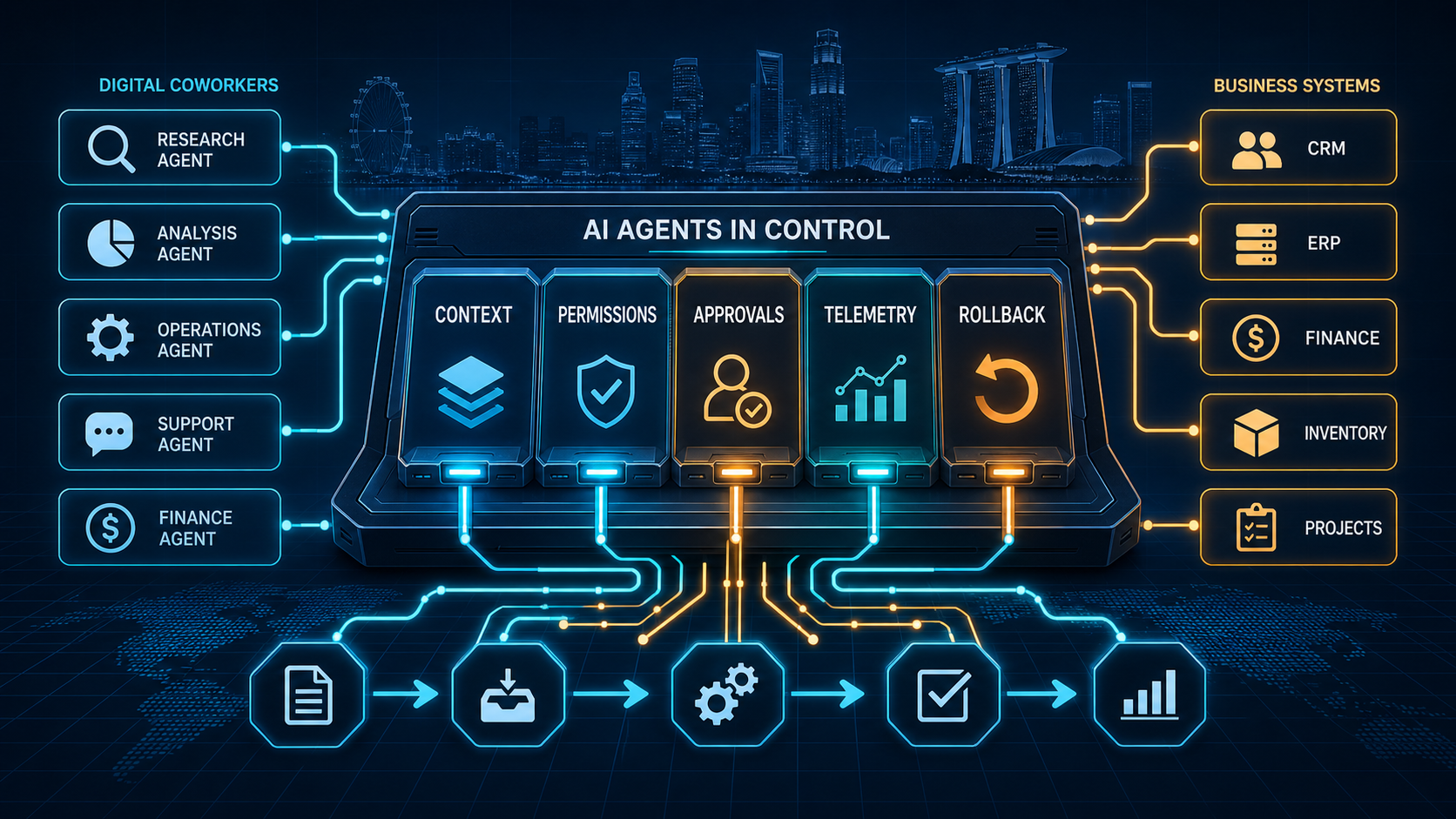
The next AI skill is not writing a better prompt.
It is knowing how to supervise an AI agent before it starts acting across workplace tools.
The signal is now visible across the market. OpenAI is positioning ChatGPT agent around multi-step task execution. Anthropic’s computer-use work shows models operating software through a screen. Google’s Gemini Enterprise and Agentspace direction puts agents around internal knowledge, workflows, and enterprise search. Microsoft’s frontier-firm framing points to AI becoming a work layer inside Microsoft 365.
For business professionals, this changes what AI training must cover. If agents can move from answer generation to execution, professionals need workflow mapping, context design, approval gates, testing, and governance. Otherwise, the organisation gets faster mistakes.
Trend Basis
AI agents are becoming digital coworkers: they can read context, use tools, prepare outputs, and sometimes take action. That is useful only when the human knows where the agent should act, ask, or stop.
The workplace gap is not technical alone. It is operating discipline. Many teams can use ChatGPT, Copilot, Gemini, Claude, or automation tools. Fewer teams can define the control gates that make agent execution safe.
1.What Agent Execution Readiness Means
Agent execution readiness is the ability to let AI participate in work without losing human control. It is not the same as AI awareness. It is also not the same as using a chatbot daily.
A ready professional can answer seven questions before using an agent:
- What workflow is the agent supporting?
- Which sources, documents, and records can it trust?
- Which tools can it access?
- What output should it prepare?
- What can it do automatically?
- What requires human approval?
- What log should remain after the work is complete?
This is where domain experts become AI architects. They do not need to code the model. They need to design the workflow boundaries.
Next Step
Download the SME Workflow Checklist
Get the exact checklist we use to spot high-ROI automation opportunities in under 15 minutes.
2.The Five Skills Professionals Need Next
Workflow mapping
Before an agent can help, the work must be visible. Map the trigger, input, owner, systems touched, decision points, approval steps, handoffs, and final outcome. If the workflow cannot be mapped, it is not ready for agent execution.
Context design
Agents need usable context: definitions, examples, templates, constraints, trusted sources, customer notes, internal rules, and what to ignore. Weak context creates confident but fragile work.
Approval-gate design
Not every action has the same risk. Professionals must decide where an agent can read, recommend, prepare, ask, act, or stop. Customer commitments, financial changes, HR actions, public claims, and sensitive data need human-in-the-loop control.
Testing and exception handling
A workflow is not ready because it worked once. Test missing data, conflicting instructions, unusual customers, stale documents, and ambiguous requests. Professionals need to know how the agent behaves when the work is messy.
Auditability and telemetry
If an agent supports business work, it should leave a record: inputs used, source links, tool actions, draft output, approver, timestamp, exception notes, and override reason. Teams should track cycle time, approval rate, correction rate, exception rate, and cost per workflow.
Next Step
Check Your SkillsFuture Subsidy
See your estimated net payable fee and eligibility path in under 60 seconds.
Check My SubsidyRelated Course Module
Module: Build Your First Agentic Workflow Blueprint
Learn how to map, automate, and test one real workflow from your own business during class.
See module details3.A Practice Exercise for Your Role
Pick one recurring task you do every week. Build a one-page agent execution map:
- Task: what recurring work should the agent support?
- Inputs: which documents, systems, and examples are trusted?
- Output: what should the agent prepare?
- Risk: what can go wrong if the output is wrong?
- Approval: what needs human review before action?
- Stop rule: when should the agent escalate instead of continuing?
- Audit trail: what evidence should remain after the workflow runs?
This exercise trains the real skill: orchestrating AI work instead of operating every tool manually.
Final Thought
Agentic AI will not stay as a side tool. It is moving toward the operating layer of work.
The professionals who win will not be the ones who prompt the most. They will be the ones who can map workflows, design context, set approval gates, read telemetry, and keep judgment in the loop.
Sources
- OpenAI: Introducing ChatGPT agent
- Anthropic: Claude 3.5 Sonnet and computer use
- Google Cloud: Agentspace / Gemini Enterprise
- Microsoft: Agentic features to accelerate the frontier firm
About the Trainer
Melverick Ng is Founder of Nexius Labs and Master Trainer at Nexius Academy. He has trained business teams and non-technical professionals to design practical AI workflows for sales, operations, and customer support.
Talk to a Course Advisor